Trick or Trade Dress? When Private-Label Products Look a Little Too Familiar
Recent lawsuits involving Aldi, Trader Joe’s, Mondelez and J.M. Smucker put the increasingly valuable “look and feel” of consumer products under the microscope.
You might feel yourself doing a doubletake – or two – as you peer out your living room window this Saturday night. Every October 31, neighborhoods worldwide transform into mashups of imitation and imagination. It can all feel a little surreal – and it can leave you questioning your own eyes.
Was Catwoman just chasing Super Mario down the block? Was that Captain Hook palling around with Peter Pan?
But while you might be fooled at first glance, the occasion – and those pillowcases half-stuffed with Kit Kats and Jolly Ranchers – will quickly bring you back to reality.
No, Sony Pictures did not dispatch the full cast of K-Pop Demon Hunters to film action scenes on your front porch. No, Dolly Parton’s saintly ghost did not rise from the grave to ring your doorbell.
However realistic or creative the costume may appear, in the end you know you’re not staring down the real thing. You know it’s only Halloween.
But when you reach for that box of vanilla wafers at Aldi or snatch up a package of those crustless PB&J sandos at Trader Joe’s … well, that’s a bit trickier.
In the private-label retail world, dress-up isn’t just for Halloween. Many regional, semi-national and even nationwide retail grocery chains rely on their own private label product versions to supplement (or even drive) their bottom lines.
Why Private Labels Are Big Business
In-house brands offer retail grocers several advantages. For one, retailers can sell their own privately made products at a discount compared to the big-name brands, who do not operate their own storefronts and must rely on retailers for shelf space (and any access worth having is not free). Retailers pocket more profit each time a shopper picks a private-label product over a name-brand option. And this cost advantage doesn’t just benefit the retailer. Grocery bills have continued to balloon in recent years, inflated by myriad pressure points that are ensnarling supply chains, accelerating shipping costs and causing other cost-increasing complications for everyday shoppers trying to make ends meet.
Every discount helps in today’s economy, and shoppers are increasingly looking out for quality options at affordable prices. All that extra attention creates even more opportunities for retailers to heighten their market profiles. Well-marketed private-label product campaigns can fuel significant retail sales increases as shoppers create their own associations with the “look and feel” of the retailer’s own branded products. Retail grocery stores can become destinations in their own right for shoppers-turned-fans of the retailer’s private-label offerings.
And with access to reams of sales data, retailers can constantly keep tabs on the buying public’s trends and habits. See a lot of Oreos flying off the shelves? Why not offer a cheaper, private-label alternative?
When a Product’s “Look and Feel” Becomes Intellectual Property
The devil may be in the details.
A product’s packaging and overall visual appearance can be just as influential to buyers’ behavior as the brand name itself. Similar to the trademark protection available for brand names and logos, trade dress – a product’s overall visual “look and feel” as presented to consumers – is another significant intellectual property right. Strong visual markers and easily recognizable packaging help brands stand out from competitors while also signifying the product’s source to the public. Any number of visual cues could be subject to trade dress protection. Anything from color scheme to font selection, to distinctive product wrapping – or even the shape and contours of the product itself – is potentially fair game.
But that doesn’t mean anything goes.
What Qualifies for Trade Dress Protection?
To qualify for trade dress protection, the claimed visual/design elements must be purely decorative or source-identifying. They cannot be functional or serve a primarily functional purpose. Product shape or a distinctive silhouette, for example, could be protectable as trade dress so long as the claimed identifiers are unique and not functionally important to the product’s consumption. Something like the contour of a classic Coca-Cola bottle qualifies as trade dress, for example, so long as it is not necessary for pouring the soda out.
Colors, color combinations or proprietary color shades can be protected as trade dress, too, if they are a truly distinctive part of the product’s overall look and feel. That orange, brown and yellow arrangement on Reese’s Peanut Butter Cups is a protected trade dress. And all those brown trucks delivering your holiday goodies are sporting UPS’ shade of “Pullman Brown,” with protection applying to “delivery, transportation and logistical services.” Graphics and layout are subject to trade dress, too – think Coke and Reese’s again, or maybe that bottle of Tide detergent you used to wash the chocolate stains out of your white shirt.
Trade dress doesn’t stop at the physical package, either. Website layouts (specific user interfaces, color palettes, online store arrangements, etc.) and other intangible elements such as atmosphere and décor (a specific cabana-style layout or motif for a Mexican restaurant, for example) can be trade-dress protected if they satisfy all requirements.
So, too, can the physical shape of the product itself. Those particular curves of a Goldfish cracker or the drop shape of a Hershey’s Kiss (also wrapped in a distinctive foil) enjoy trade dress protection.
Distinctiveness and Trade Dress Protection
Again, however, all visual/design cues still must be sufficiently distinctive to qualify as a protected trade dress. This means they must either be “inherently distinctive” (creating a truly unique look that easily identifies the brand in consumers’ minds) or otherwise must have acquired “secondary meaning” (which requires a showing that the public has come to associate the claimed cue with the product over a period of time).
As with all trademark rights, the primary goal of trade dress is consumer protection. Brand identifiers let consumers know the source of the products they are buying, which helps them feel assured that a product possesses the desired quality before paying the asking price. Trademark rights, including trade dress, help brands protect their products from customer confusion.
Why Trade Dress Can Be So Valuable
At the same time, brands use their trade dress as a way to build up goodwill with the purchasing public. Brand identifiers help introduce the brand’s products to potential customers. Catchy identifiers help popularize brands and can even create demand for products that perhaps did not exist before.
A good trade dress is valuable. A great one can be worth a fortune and well worth a sizable investment to both develop and protect. So, when private-label retailers start selling cheaper alternatives, the big-name brands take careful notice. Even though the private-label brand is sold under a different name, the big brands are scrutinizing every detail and making a deeper comparison. Does the packaging feature a similar color scheme? Do the products themselves look like they could be twins?
The issue runs deeper than whether the consumer is simply duped as to who makes which product version. A similar-looking package might suggest false equivalence in product quality, for example. Or the consumer’s awareness of the product’s existence or desire to purchase it at all might result entirely from the established brand’s initial investment and development. In that instance, the competitor may be unfairly capitalizing on the original brand’s time and money.
So, where is the line between creative marketing and trade-dress infringement? Aldi and Trader Joe’s are still trying to find out.
Mondelez v. Aldi: When “Like Brands, Only Cheaper” Looks Too Much Like the Brand
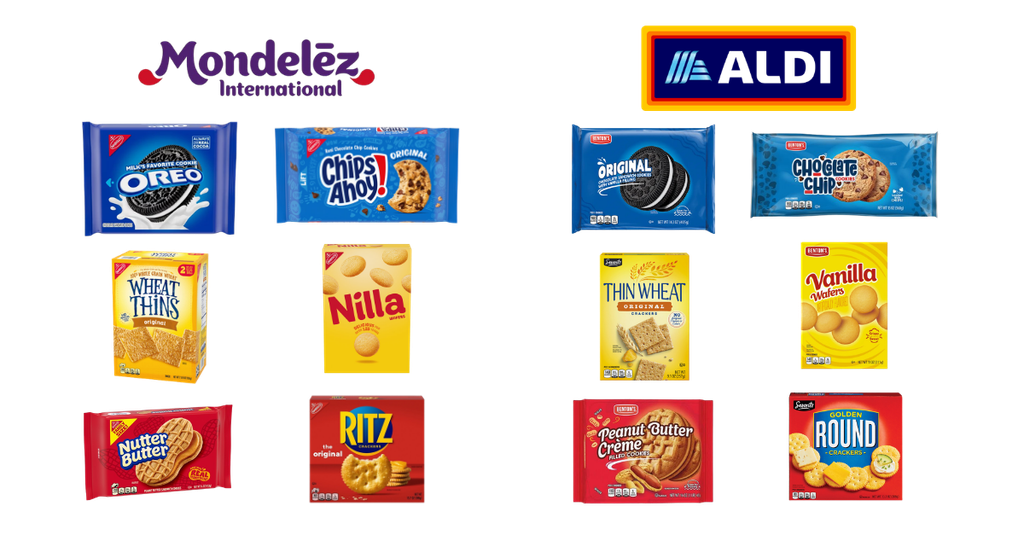
Last year, global snack and confectionary mogul Mondelez International, which owns and operates Nabisco as a subsidiary, sued Aldi in the U.S. District Court for the Northern District of Illinois, claiming that Aldi was “willfully” infringing its trade dress by marketing several of its private-label products via packaging and font designs confusingly similar to products sold under Mondelez-owned brands. The Mondelez products at issue include Oreo, Wheat Thins, Nutter Butter, Chips Ahoy!, Ritz, Premium and Nilla Wafers.
For years, Aldi has been attracting customers to its stores with the moniker “like brands, only cheaper.” However, to Mondelez, these packages felt a little too on the nose:
Smucker v. Trader Joe’s: Is a Crustless Sandwich Protectable?
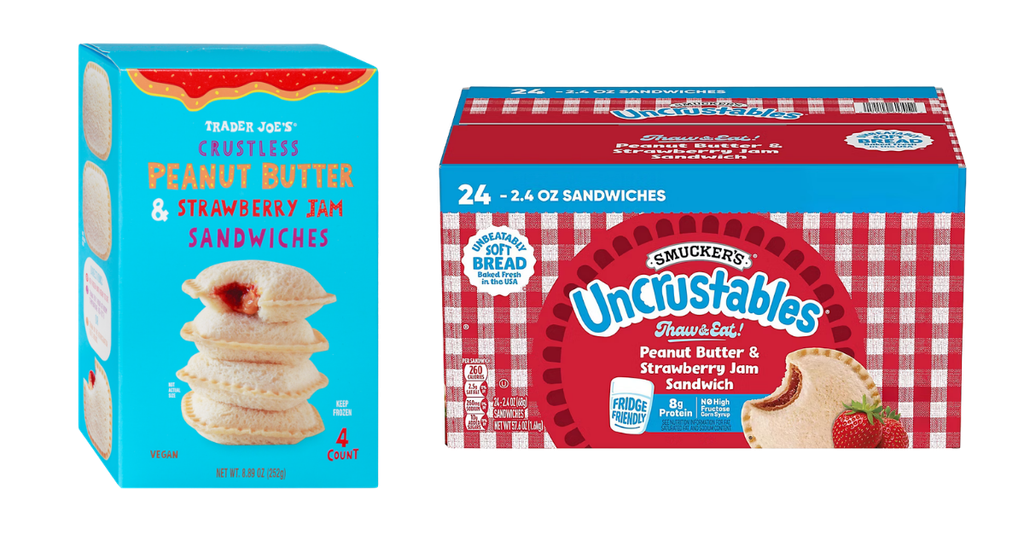
Meanwhile, jelly and jam magnate JM Smucker filed suit against Trader Joe’s, claiming that the retailer’s marketing and sales of its Crustless Peanut Butter & Strawberry Jam Sandwiches, are essentially identical in appearance as the Uncrustables that Smucker has been selling since 1990. In the suit, pending in the U.S. District Court for the Northern District of Ohio, Smucker claims to have spent over $1 billion in the past 20 years developing Uncrustables into a widely-known commodity.
While there are some aspects of font choice and color scheme at play in this suit, the primary dispute concerns the allegedly identical appearance of the sandwiches themselves. Smucker claims trade dress protection to the pudgy, round crustless sandwiches that feature “distinct peripheral undulated crimping” all the way around. Smucker further takes issue with Trader Joe’s choice to depict the sandwiches “with a bite taken out of” them, claiming a design mark to that look as well:
Lessons from the Litigation So Far
Both Aldi and Trader Joe’s tried unsuccessfully to dismiss their respective lawsuits at preliminary stages, with Trader Joe’s motion having just recently been denied on August 28, 2026. Both matters are now progressing through discovery, and both cases have already produced some notable developments.
ALDI’s Private-Label Strategy Pivot
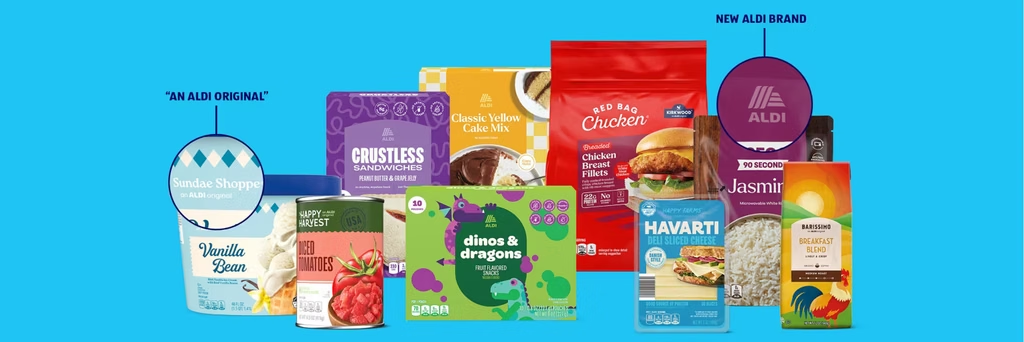
Since the Mondelez lawsuit was filed, Aldi has pivoted its branding approach. It has consolidated its brand offerings (reportedly down from 90 to 26) and it more prominently features the “Aldi” name or the phrase “an Aldi Original” in highly visible locations. It has also refreshed some color schemes and leaned into marketing some of its privately-owned brands as superior options in their own right. Some of its smaller brand lines are now further discounted, while the more popular products are being emphasized as Aldi “originals:”
When Trade Dress Collides With Functionality
In the Trader Joe’s lawsuit, the perils of claiming physical product attributes as trade dress are on display. In its filings, Trader Joe’s has argued that the crimped edges featured in both litigants’ products are more functional than decorative or visual. In fact, Trader Joe’s pointed out that Smucker had itself previously sought a utility patent for the crimping technique, arguing its utility for keeping the filling inside of the sandwiches.
Round Sandwich or “Squircle”?
The parties have even disagreed over what their competing products actually look like. Smucker claims that both parties’ sandwiches are circular while Trader Joe’s contends that its sandwiches are actually “squircles” – square sandwiches with rounded edges. You were probably never asked to calculate the circumference of a squircle in geometry class. But every difference in physical appearance, no matter how subtle, could affect the outcome of a product-shape trade dress dispute.
What These Cases Could Mean for Brands and Retailers
Both of these pending cases underscore just how fact-dependent trade dress disputes can tun out to be. Protection depends on how recognizable the overall “look and feel” of a product’s marketing scheme is to consumers. Focusing on any one visual or physical attribute can present more, not less, challenges. And choosing a marketing scheme with elements similar to an existing brand could very well draw a legal challenge that is not so easy to simply swat away.
Social Media May Become Evidence, Too
Interestingly, both matters also underscore how social media and its profound effects on consumer behavior and marketing techniques can be a double-edged sword for trade dress litigants.
In Aldi’s case, social media posts featuring customer reactions to its new labels and packaging may provide tangible evidence of customers’ affection for Aldi’s own branded products. Posts depicting consumer conversation about, and identification with, Aldi “originals” may support an argument that consumers have purposely selected Aldi products all along.
Meanwhile, Smucker has pointed to social media posts of consumers openly wondering whether Trader Joe’s had received “permission” to sell crustless sandwiches as evidence of Smucker’s superior brand recognition. All these extra data points are fodder for trade dress litigants in a process that is growing even more complex.
Conclusion: Proceed With Caution
Private-label grocery retail has proven an interesting and potentially consequential trade dress battleground. The line between clever marketing and imitation can indeed be blurry and disorienting. Sometimes it is hard to tell the difference between a valid infringement argument and an attempt to fit a round peg into a square hole.
Or is that a squircle? It must be Halloween.